
Perkin-Elmer PHI 660 - AES - Status: Down
General Information
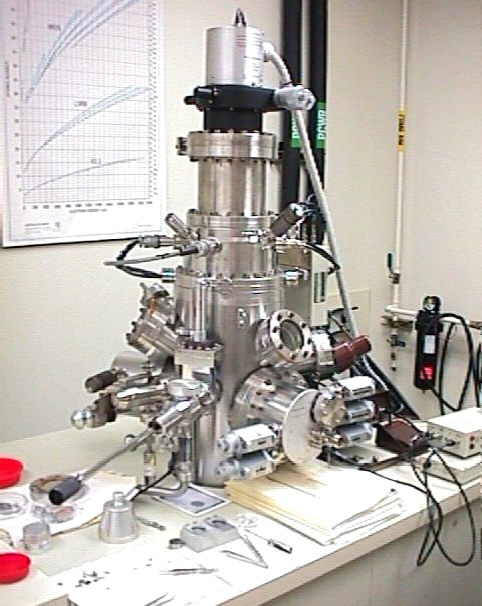
- Current Status:
- Down
- Use Rates:
- External Academic & Government:
- $57.30/Hour
- External Affiliated Commercial/Industrial:
- $164.00/Hour
- External Commercial/Industrial:
- $219.00/Hour
- External International Academic:
- $76.40/Hour
- Internal Standard:
- $38.20/Hour
- Service:
- Request Service Quote. The Staff rate is $50/hour (Internal) and $55 /hour (External) in addition to the instrument rate.
- Building:
- NANO (0070)
- In Cleanroom:
- No
- Main Contact:
- Brent Gila
Description
Scanning Auger Multiprobe:
is a common analytical technique used specifically
in the compositional study of surfaces.
TRAINING READING REQUIREMENTS:
Chapter 5.3 "Encyclopedia of Materials Characterization”
Publisher: Butterworth-Heinemann
ISBN-10: 0750691689
ISBN-13: 978-0750691680
Copy available on request.
Capabilities
Scanning Auger Multiprobe:
Typical Applications: Surface Analysis and Depth Profiling
Signal Detected: Auger electrons
Elements Detected: Li-U
Detection Limits: 0.1 – 1 at%
5 – 50 Angstroms
Imaging/Mapping: Yes
Lateral Resolution/Probe Size: 5,000 Angstroms
The AES uses a finely focused electron beam to determine the elementals present in the top 3-4 atomic layers on a solid surface. All elements except H and He can be detected but the sample must be electrically conducting or semi conducting.
The Perkin-Elmer PHI 660 scanning Auger microprobe uses a LaB6 filament to probe the surface of a solid sample generating Auger electrons originating from the top surface of a sample in an ultra high vacuum (<10E-9 torr). It is capable of producing elemental maps or lie scans with a lateral resolution of less than 1 um. The machine is equipped with an Ar ion gun to remove surface layers and produce a depth profile of the distribution of the elements in the Z direction. Also available is an in situ fracture stage to create a fresh surface under UHV conditions.
An active Gatorlink login is required to create a new reservation.
